SNF's environmental strategy addresses greenhouse-gas emissions, product design, product stewardship, pollution prevention, water management, and circular resource use. The chapter describes both the Group's operational footprint and the positive environmental outcomes its water-treatment technologies can enable for customers.
2 pagesChapter Introduction
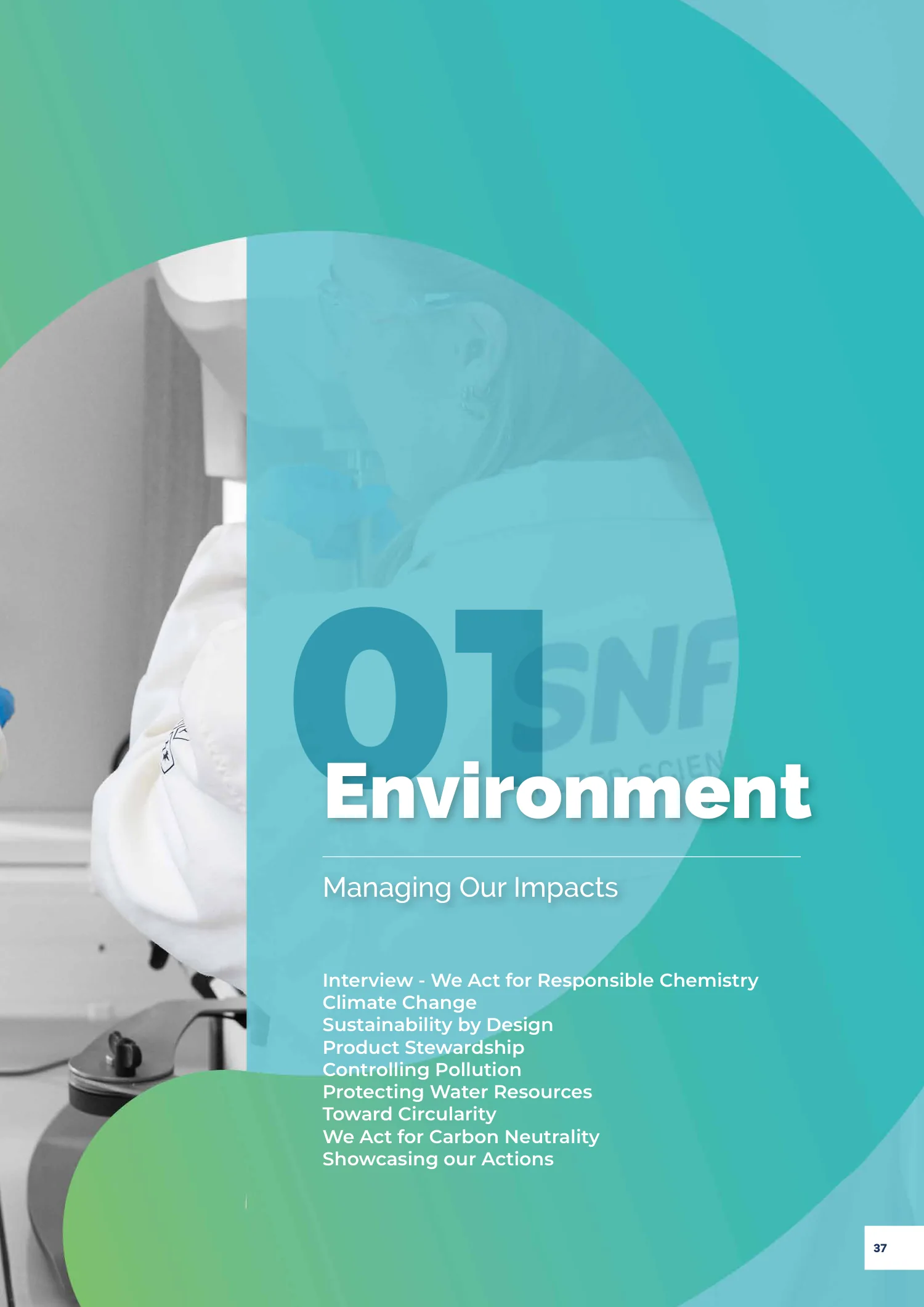
The Environment chapter explains how SNF manages operational impacts while helping customers improve water and resource efficiency. Its priorities include climate action, responsible chemistry, pollution control, water stewardship, and circularity.
Accessible text version of this section
Report page 37
01 Environment
Managing Our Impacts
Interview - We Act for Responsible Chemistry Climate Change Sustainability by Design Product Stewardship Controlling Pollution Protecting Water Resources Toward Circularity We Act for Carbon Neutrality Showcasing our Actions
2 pagesInterview: We Act for Responsible Chemistry
Cynthia Garduno of BM Allied Chemicals discusses local partnerships, innovation, customer expectations, and the practical application of responsible chemistry. The interview illustrates how Group commitments are translated into market-specific action and continuous improvement.
Accessible text version of this section
Report page 38
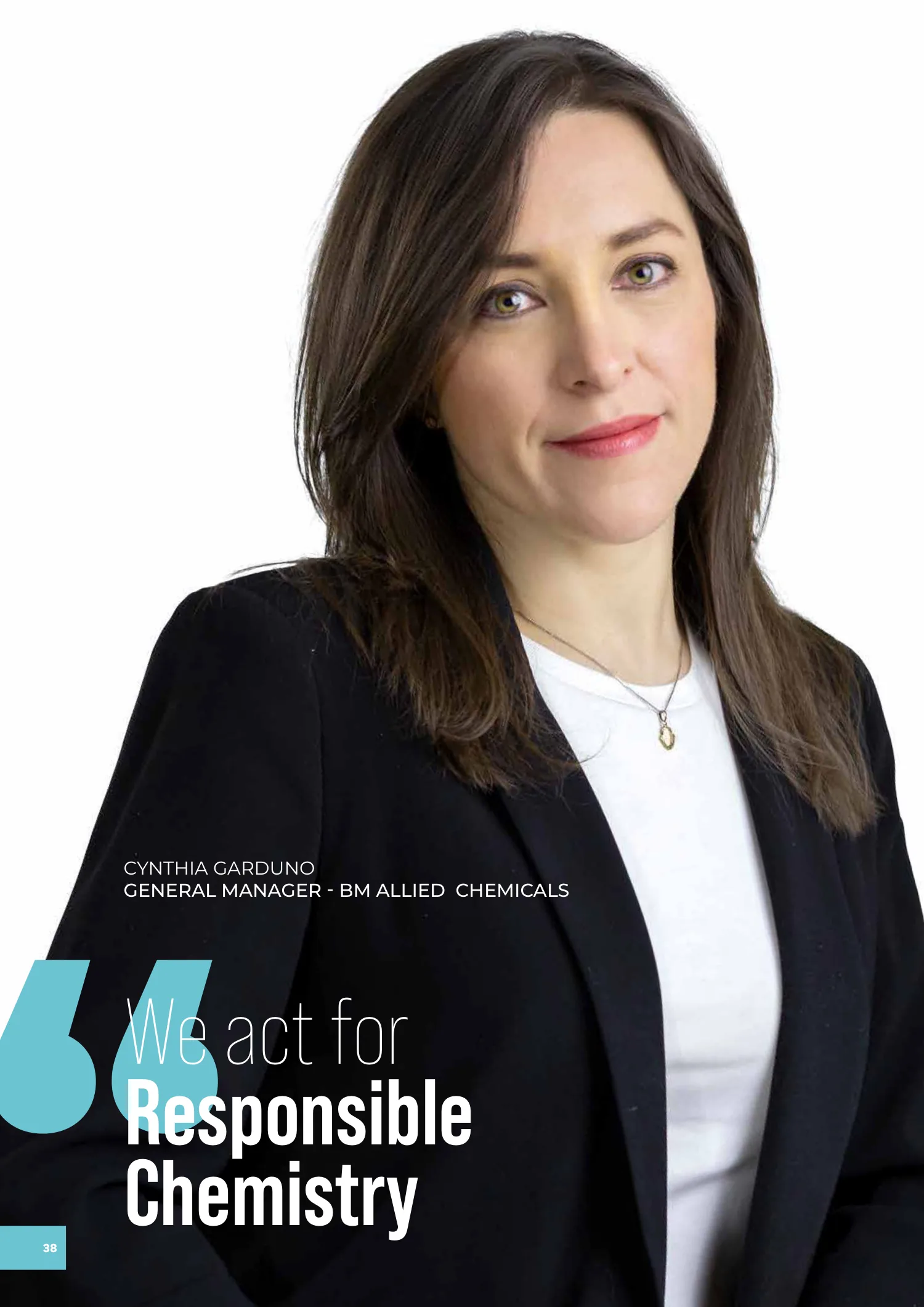
CYNTHIA GARDUNO GENERAL MANAGER - BM ALLIED CHEMICALS
“ We act for Responsible Chemistry
Report page 39
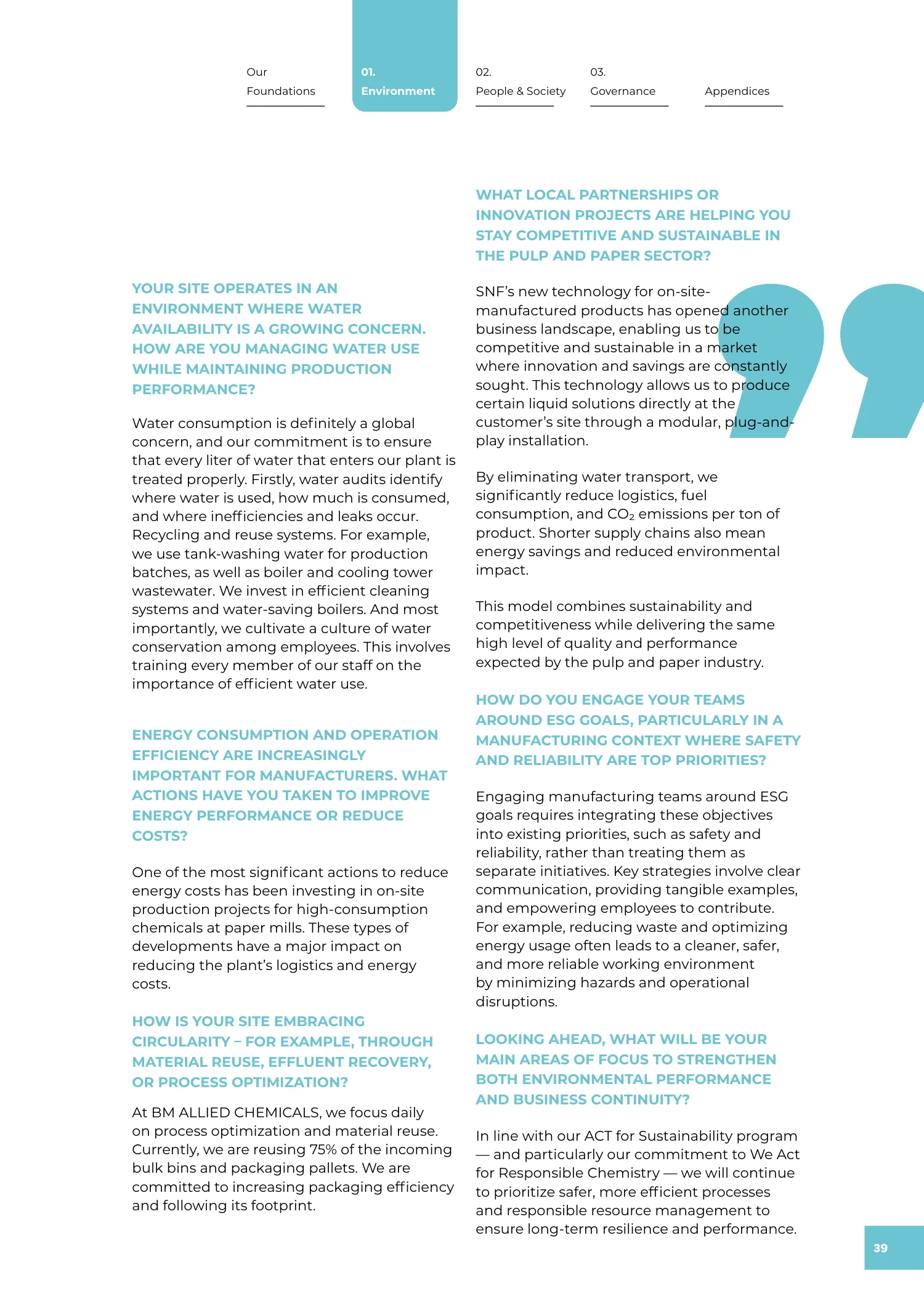
YOUR SITE OPERATES IN AN ENVIRONMENT WHERE WATER AVAILABILITY IS A GROWING CONCERN. HOW ARE YOU MANAGING WATER USE WHILE MAINTAINING PRODUCTION PERFORMANCE?
Water consumption is definitely a global concern, and our commitment is to ensure that every liter of water that enters our plant is treated properly. Firstly, water audits identify where water is used, how much is consumed, and where inefficiencies and leaks occur. Recycling and reuse systems. For example, we use tank-washing water for production batches, as well as boiler and cooling tower wastewater. We invest in efficient cleaning systems and water-saving boilers. And most importantly, we cultivate a culture of water conservation among employees. This involves training every member of our staff on the importance of efficient water use.
ENERGY CONSUMPTION AND OPERATION EFFICIENCY ARE INCREASINGLY IMPORTANT FOR MANUFACTURERS. WHAT ACTIONS HAVE YOU TAKEN TO IMPROVE ENERGY PERFORMANCE OR REDUCE COSTS?
One of the most significant actions to reduce energy costs has been investing in on-site production projects for high-consumption chemicals at paper mills. These types of developments have a major impact on reducing the plant’s logistics and energy costs.
HOW IS YOUR SITE EMBRACING CIRCULARITY - FOR EXAMPLE, THROUGH MATERIAL REUSE, EFFLUENT RECOVERY, OR PROCESS OPTIMIZATION?
At BM ALLIED CHEMICALS, we focus daily on process optimization and material reuse. Currently, we are reusing 75% of the incoming bulk bins and packaging pallets. We are committed to increasing packaging efficiency and following its footprint.
WHAT LOCAL PARTNERSHIPS OR INNOVATION PROJECTS ARE HELPING YOU STAY COMPETITIVE AND SUSTAINABLE IN THE PULP AND PAPER SECTOR?
SNF’s new technology for on-site-manufactured products has opened another business landscape, enabling us to be competitive and sustainable in a market where innovation and savings are constantly sought. This technology allows us to produce certain liquid solutions directly at the customer’s site through a modular, plug-and-play installation.
By eliminating water transport, we significantly reduce logistics, fuel consumption, and CO₂ emissions per ton of product. Shorter supply chains also mean energy savings and reduced environmental impact.
This model combines sustainability and competitiveness while delivering the same high level of quality and performance expected by the pulp and paper industry.
HOW DO YOU ENGAGE YOUR TEAMS AROUND ESG GOALS, PARTICULARLY IN A MANUFACTURING CONTEXT WHERE SAFETY AND RELIABILITY ARE TOP PRIORITIES?
Engaging manufacturing teams around ESG goals requires integrating these objectives into existing priorities, such as safety and reliability, rather than treating them as separate initiatives. Key strategies involve clear communication, providing tangible examples, and empowering employees to contribute. For example, reducing waste and optimizing energy usage often leads to a cleaner, safer, and more reliable working environment by minimizing hazards and operational disruptions.
LOOKING AHEAD, WHAT WILL BE YOUR MAIN AREAS OF FOCUS TO STRENGTHEN BOTH ENVIRONMENTAL PERFORMANCE AND BUSINESS CONTINUITY?
In line with our ACT for Sustainability program - and particularly our commitment to We Act for Responsible Chemistry - we will continue to prioritize safer, more efficient processes and responsible resource management to ensure long-term resilience and performance.
4 pages1.1 Climate Change
SNF's climate strategy covers Scope 1, Scope 2, and Scope 3 emissions and supports a long-term carbon-neutrality target for 2050. The section addresses emissions measurement, transition planning, climate-related risks and opportunities, supplier engagement, internal carbon pricing, and customer-enabled avoided impacts.
Accessible text version of this section
Report page 40
1.1 Climate Change
Managing Climate-related Impacts
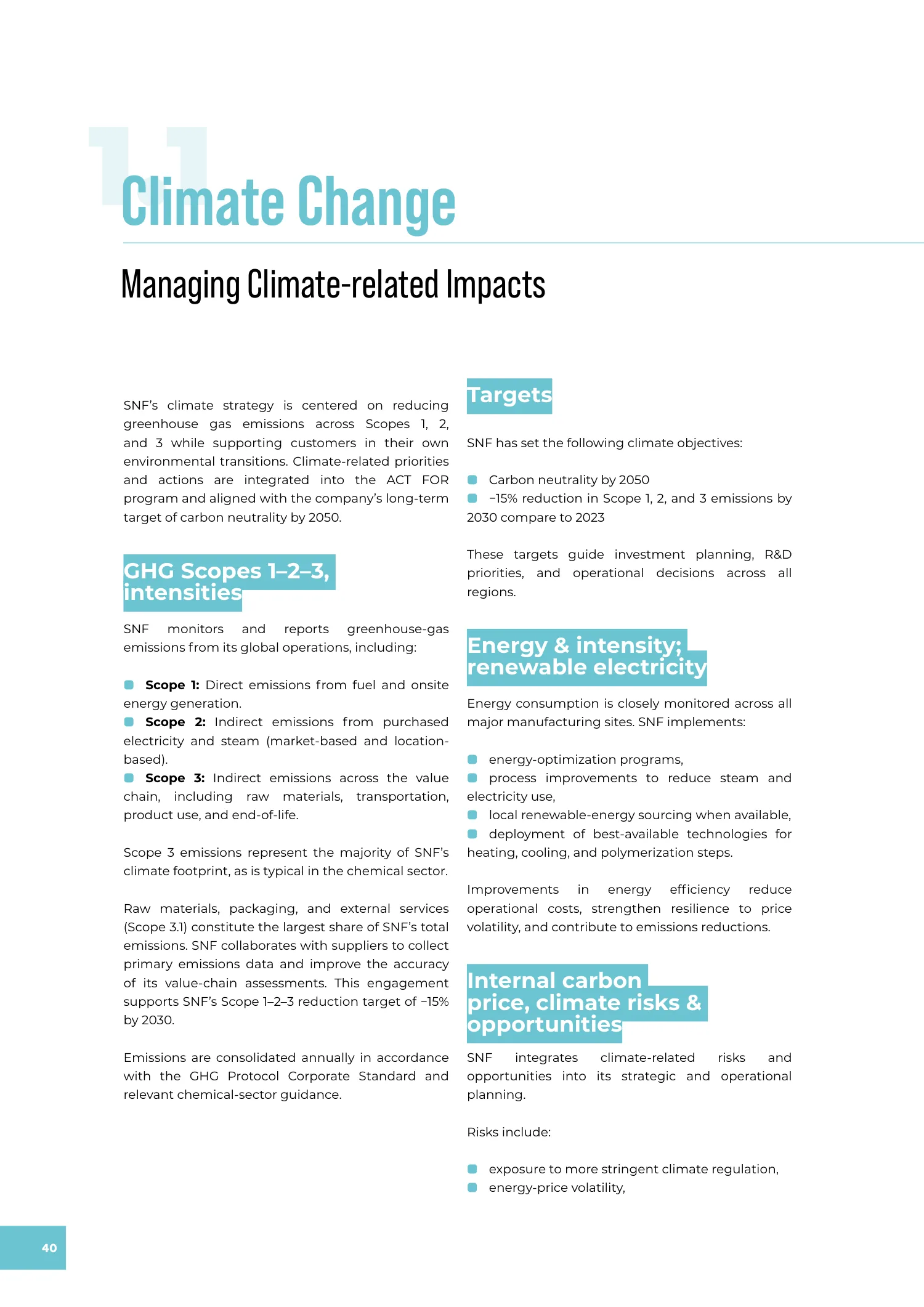
SNF’s climate strategy is centered on reducing greenhouse gas emissions across Scopes 1, 2, and 3 while supporting customers in their own environmental transitions. Climate-related priorities and actions are integrated into the ACT FOR program and aligned with the company’s long-term target of carbon neutrality by 2050.
GHG Scopes 1-2-3, intensities
SNF monitors and reports greenhouse-gas emissions from its global operations, including:
• Scope 1: Direct emissions from fuel and onsite energy generation.
• Scope 2: Indirect emissions from purchased electricity and steam (market-based and location-based).
• Scope 3: Indirect emissions across the value chain, including raw materials, transportation, product use, and end-of-life.
Scope 3 emissions represent the majority of SNF’s climate footprint, as is typical in the chemical sector.
Raw materials, packaging, and external services (Scope 3.1) constitute the largest share of SNF’s total emissions. SNF collaborates with suppliers to collect primary emissions data and improve the accuracy of its value-chain assessments. This engagement supports SNF’s Scope 1-2-3 reduction target of -15% by 2030.
Emissions are consolidated annually in accordance with the GHG Protocol Corporate Standard and relevant chemical-sector guidance.
Targets
SNF has set the following climate objectives:
• Carbon neutrality by 2050
• -15% reduction in Scope 1, 2, and 3 emissions by 2030 compare to 2023
These targets guide investment planning, R&D priorities, and operational decisions across all regions.
Energy & intensity; renewable electricity
Energy consumption is closely monitored across all major manufacturing sites. SNF implements:
• energy-optimization programs,
• process improvements to reduce steam and electricity use,
• local renewable-energy sourcing when available,
• deployment of best-available technologies for heating, cooling, and polymerization steps.
Improvements in energy efficiency reduce operational costs, strengthen resilience to price volatility, and contribute to emissions reductions.
Internal carbon price, climate risks & opportunities
SNF integrates climate-related risks and opportunities into its strategic and operational planning.
Risks include:
• exposure to more stringent climate regulation,
• energy-price volatility,
Report page 41
ESRS E1
• supply-chain risks linked to emissions requirements, • physical risks such as water scarcity and extreme weather events.
Opportunities include:
• growing demand for low-carbon and energy-efficient products, • increasing customer requirements for Scope-3 reduction, • development of renewable or circular raw materials, • adoption of advanced water-treatment technologies with climate-positive effects.
SNF uses an internal carbon price to evaluate investment options and guide resource-efficiency initiatives.
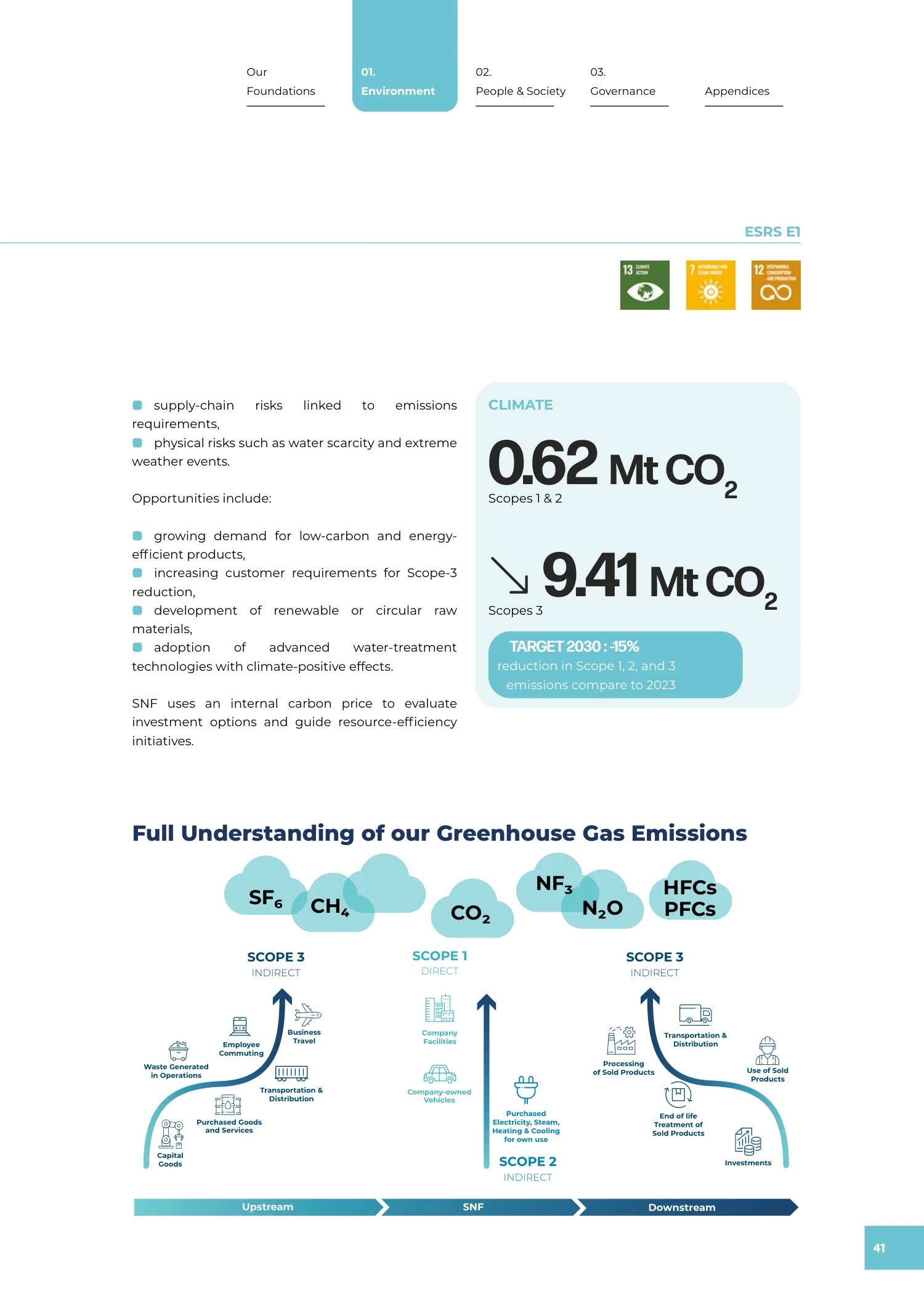
CLIMATE 0.62 Mt CO2 Scopes 1 & 2
9.41 Mt CO2 Scopes 3
TARGET 2030 : -15% reduction in Scope 1, 2, and 3 emissions compare to 2023
Report page 42
Transition Plan
Our pathway to net zero
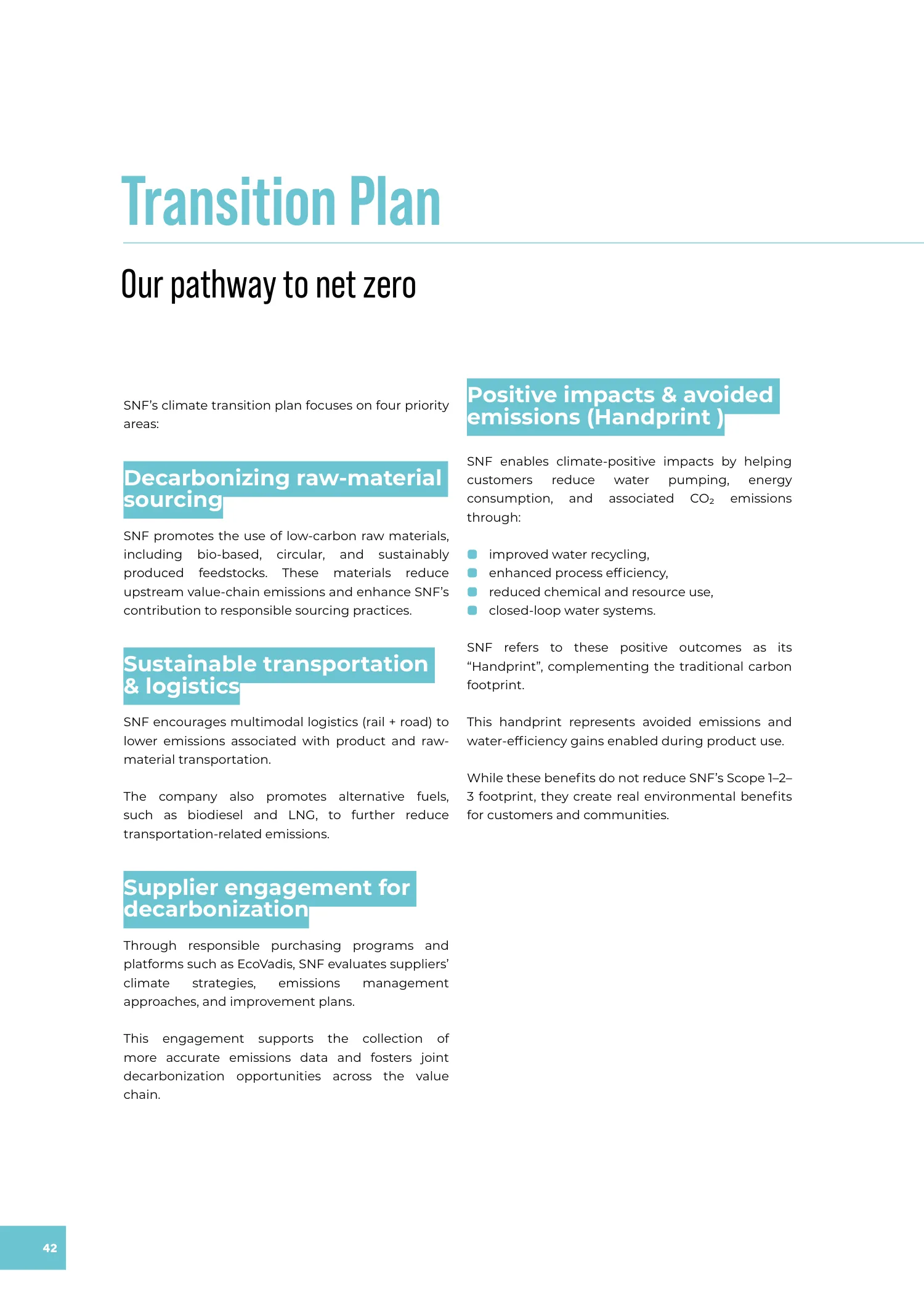
SNF’s climate transition plan focuses on four priority areas:
Decarbonizing raw-material sourcing
SNF promotes the use of low-carbon raw materials, including bio-based, circular, and sustainably produced feedstocks. These materials reduce upstream value-chain emissions and enhance SNF’s contribution to responsible sourcing practices.
Sustainable transportation & logistics
SNF encourages multimodal logistics (rail + road) to lower emissions associated with product and raw-material transportation.
The company also promotes alternative fuels, such as biodiesel and LNG, to further reduce transportation-related emissions.
Supplier engagement for decarbonization
Through responsible purchasing programs and platforms such as EcoVadis, SNF evaluates suppliers’ climate strategies, emissions management approaches, and improvement plans.
This engagement supports the collection of more accurate emissions data and fosters joint decarbonization opportunities across the value chain.
Positive impacts & avoided emissions (Handprint )
SNF enables climate-positive impacts by helping customers reduce water pumping, energy consumption, and associated CO₂ emissions through:
• improved water recycling,
• enhanced process efficiency,
• reduced chemical and resource use,
• closed-loop water systems.
SNF refers to these positive outcomes as its “Handprint”, complementing the traditional carbon footprint.
This handprint represents avoided emissions and water-efficiency gains enabled during product use.
While these benefits do not reduce SNF’s Scope 1-2-3 footprint, they create real environmental benefits for customers and communities.
Report page 43
ESRS E1
2 pagesWe Act for Carbon Neutrality
SNF's 2023-2025 decarbonization projects include electrification, renewable energy, process improvements, energy recovery, and lower-carbon technologies across multiple sites. The project map identifies annual emissions reductions associated with operational investments around the world.
Accessible text version of this section
Report page 44
#We ACT for Carbon Neutrality
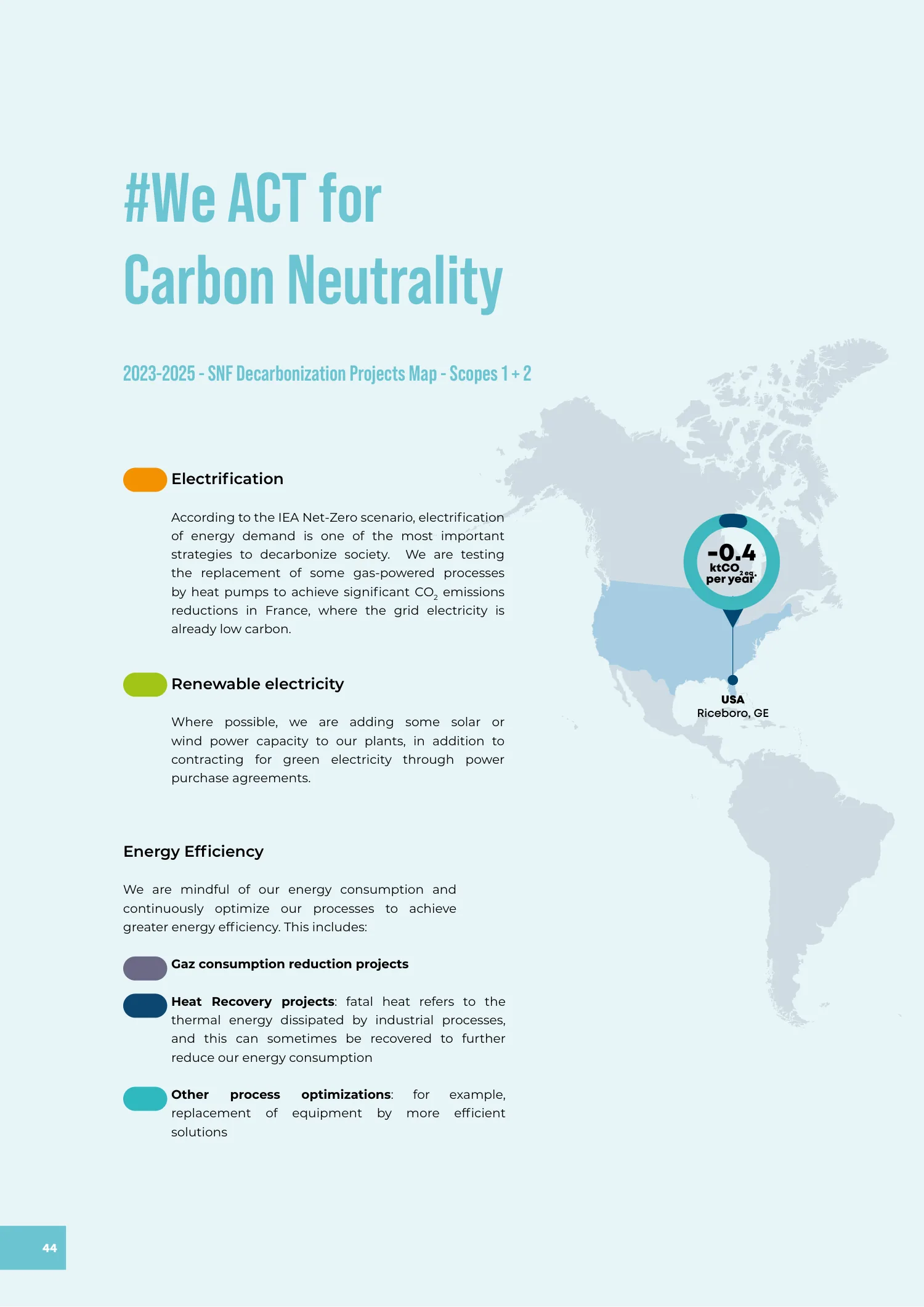
2023-2025 - SNF Decarbonization Projects Map - Scopes 1 + 2
Electrification
According to the IEA Net-Zero scenario, electrification of energy demand is one of the most important strategies to decarbonize society. We are testing the replacement of some gas-powered processes by heat pumps to achieve significant CO2 emissions reductions in France, where the grid electricity is already low carbon.
Renewable electricity
Where possible, we are adding some solar or wind power capacity to our plants, in addition to contracting for green electricity through power purchase agreements.
Energy Efficiency
We are mindful of our energy consumption and continuously optimize our processes to achieve greater energy efficiency. This includes:
Gaz consumption reduction projects
Heat Recovery projects: fatal heat refers to the thermal energy dissipated by industrial processes, and this can sometimes be recovered to further reduce our energy consumption
Other process optimizations: for example, replacement of equipment by more efficient solutions
-0.4 ktCO2 eq per year*
USA Riceboro, GE
Report page 45
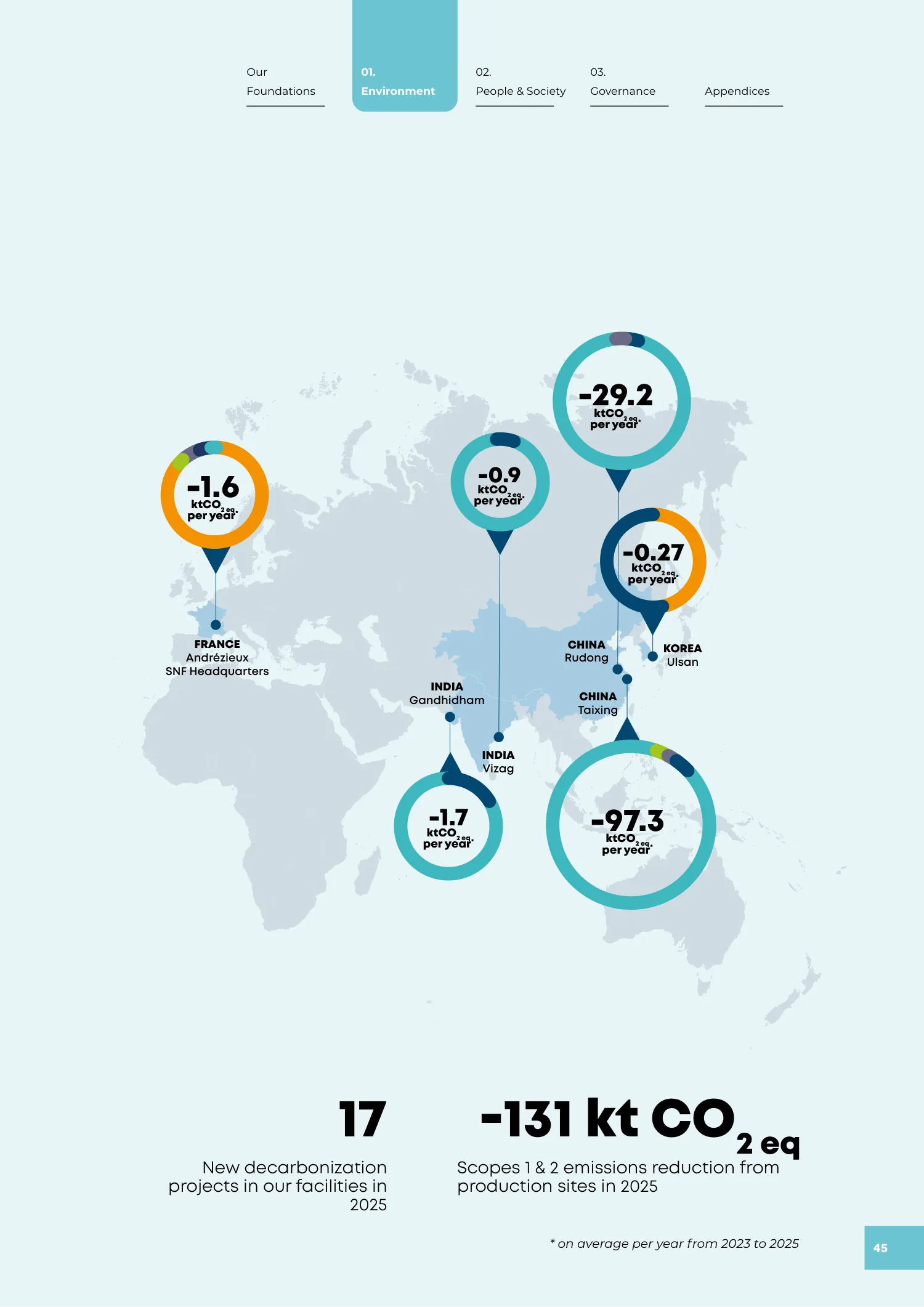
FRANCE Andrézieux SNF Headquarters -1.6 ktCO2 eq per year*
INDIA Vizag -0.9 ktCO2 eq per year*
CHINA Rudong -29.2 ktCO2 eq per year*
KOREA Ulsan -0.27 ktCO2 eq per year*
INDIA Gandhidham -1.7 ktCO2 eq per year*
CHINA Taixing -97.3 ktCO2 eq per year*
17 New decarbonization projects in our facilities in 2025
-131 kt CO2 eq Scopes 1 & 2 emissions reduction from production sites in 2025
* on average per year from 2023 to 2025
2 pages1.2 Sustainability by Design
Sustainability by Design integrates environmental and safety considerations into research, product development, raw-material selection, and production. SNF evaluates product performance, carbon footprint, hazardous substances, renewable content, biodegradability, and customer application benefits.
Accessible text version of this section
Report page 46
1.2 Sustainability by Design
Designing Chemistry for Long-Term Impact
At SNF, sustainability is integrated from the earliest stages of product development. Our approach to “Sustainability by Design” ensures that environmental considerations are embedded into molecular structure, process engineering, and lifecycle evaluation. Rather than treating sustainability as an adjustment at the end of production, we incorporate it upstream -during research, formulation, and raw-material selection. This approach enables us to reduce environmental impacts at the source while maintaining performance and reliability across industrial applications.
Responsible Chemistry as a Foundation
Our Responsible Chemistry Policy guides this approach across the value chain - from sourcing greener raw materials to designing polymers that improve biodegradability and operational efficiency. We progressively transition from traditional fossil-based inputs toward more sustainable alternatives with reduced environmental footprints. Throughout product development, we aim to exceed regulatory standards and apply green-chemistry principles that minimize ecological impact.
Environmental Fate of Polymers
Understanding and improving the environmental fate of our polymers is a key component of Sustainability by Design. SNF takes a comprehensive approach based on extensive literature reviews and structural evaluations to understand how polymers behave across different environmental contexts.
Our strategy includes in-depth studies of both biotic and abiotic degradation mechanisms to identify the structural parameters that influence biodegradability and environmental breakdown. By examining these factors, we fine-tune polymer structures to support environmentally friendly degradation across a range of applications. Depending on the context of use, environmental fate may differ, for example:
• Enhanced Oil Recovery (EOR): polymers are mostly sequestered in geological formations.
• Personal Care: polymers such as SNF’s Natursol® ML serve as rheology modifiers, offering superior biodegradability and undergoing rigorous testing such as OECD 301F to ensure compliance with global biodegradability standards.
• Polymers are utilized in sludge treatment, contributing to efficient solid-liquid separation and enabling water recycling.
White Biotechnology & Process Innovation
Sustainability by Design also includes expanding the use of white biotechnology. SNF increasingly integrates enzymes and biological pathways to enhance polymerization efficiency and reduce waste generation, while improving energy performance compared to conventional synthesis. Our primary monomer, acrylamide, is produced through enzymatic processes, significantly reducing energy use and emissions relative to traditional chemical routes.
Report page 47
Reducing Hazardous Substances
Designing sustainable products also means minimizing hazardous substances wherever feasible.
We prioritize the reduction and substitution of hazardous substances during product design. Recent innovations include:
• paraben-free polymers,
• VOC-reduced liquid polymers using plant-based feedstocks,
• phosphorus-free scale inhibitors to mitigate eutrophication,
• improved biodegradability and environmental-fate profiles.
Maximizing Resource Efficiency
Guided by atom-economy principles, SNF continuously optimizes polymerization processes to improve the incorporation of raw materials into final products. Higher atom efficiency reduces waste generation and lowers environmental impacts associated with disposal.
Research & Collaboration
Sustainability by Design is supported by strong R&D capabilities and global collaboration.
By partnering with academic institutions and industrial experts, we accelerate innovation and develop high-performance solutions aligned with evolving environmental expectations.
ESRS E1
2 pages1.3 Product Stewardship
SNF manages products across their lifecycle through regulatory compliance, hazard assessment, safety documentation, customer support, and responsible-use guidance. Product stewardship also includes transparency, training, transport safety, and continuous monitoring of regulatory and scientific developments.
Accessible text version of this section
Report page 48
1.3 Product Stewardship
Managing Products Responsibly Across Their Lifecycle
Product Stewardship is a central pillar of SNF’s Responsible Chemistry approach. It ensures that environmental, health, and safety considerations are systematically integrated throughout the entire product lifecycle - from raw-material sourcing and design to manufacturing, customer use, and end-of-life.
SNF’s Product Stewardship framework combines regulatory compliance, risk assessment, and continuous improvement to guarantee that products are developed, produced, and handled responsibly across global markets.
Lifecycle Risk Assessment
SNF conducts chemical risk assessments across the product lifecycle to identify potential impacts on human health and the environment. These evaluations consider:
• intrinsic substance properties,
• exposure scenarios,
• regulatory classification,
• downstream application conditions.
Risk assessments are updated in line with evolving scientific knowledge and regulatory developments.
Where applicable, SNF applies substitution principles to reduce or eliminate hazardous substances. Substances of Very High Concern (SVHC) are actively monitored, and carcinogenic, mutagenic, or reprotoxic (CMR) substances are replaced whenever technically and economically feasible.
Regulatory Compliance & Monitoring
SNF ensures compliance with international chemical regulations, including REACH and other applicable regional frameworks.
Compliance mechanisms include:
• systematic review and update of Safety Data Sheets (SDS),
• hazardous-substance management procedures,
• regulatory watch and monitoring systems,
• internal compliance audits across production and R&D,
• lifecycle-based product evaluations.
These processes ensure that products meet regulatory requirements in all markets where SNF operates.
Report page 49
Customer Transparency & Responsible Use
SNF supports customers in the safe and responsible use of its products by providing clear technical documentation, updated Safety Data Sheets, and regulatory guidance.
Customer engagement forms part of Product Stewardship. SNF collaborates with industrial partners to ensure that product applications align with environmental, safety, and performance standards.
Through participation in the Responsible Care® initiative, SNF promotes safe chemical management practices globally and contributes to industry-wide improvement in product stewardship standards.
Product Stewardship also encompasses customer health and safety considerations. Before market introduction, products undergo regulatory and safety evaluation to ensure compliance with applicable requirements. SNF monitors product-related risks throughout their commercial lifecycle and addresses any safety concern through structured internal procedures.
Continuous Improvement
Product Stewardship is embedded within SNF’s quality and environmental management systems. Continuous monitoring, internal audits, and corrective-action processes ensure that product-related risks are proactively managed and that improvements are systematically implemented.
By integrating compliance, transparency, and risk management into everyday operations, SNF reinforces its commitment to responsible chemical management across its global footprint.
ESRS E1
2 pages1.4 Controlling Pollution
SNF manages potential air, water, and soil impacts through engineering controls, operational procedures, monitoring, and environmental management systems. The section covers emissions prevention, incident preparedness, site-level improvement plans, and participation in Responsible Care.
Accessible text version of this section
Report page 50
1.4 Controlling Pollution
Air, Water, and Soil
SNF’s activities involve the handling, transformation, and use of chemical substances that may generate emissions to air and water. Pollution prevention is an essential part of the Group’s sustainability commitments and is integrated across product development, manufacturing, and downstream use. SNF’s approach is aligned with its Responsible Chemistry Policy and Product Stewardship principles and supports customers in meeting increasingly stringent environmental requirements.
Air emissions
SNF monitors key atmospheric emissions associated with polymer production processes, including volatile organic compounds (VOCs), nitrogen oxides (NOx), sulfur oxides (SOx), particulate matter (PM), and hazardous air pollutants (HAP). Emissions are tracked in accordance with local permits and regulatory frameworks.
Where needed, SNF deploys air-emission control technologies such as:
• gas scrubbers,
• filtration systems,
• vapor recovery systems,
• optimized ventilation and containment.
Continuous-improvement initiatives focus on process optimization, reducing volatile components in liquid polymers, and substituting substances that contribute to air emissions.
Water pollutants
SNF generates industrial wastewater streams that vary by site and production activity. The Group monitors and reports key water-pollution indicators such as:
• Chemical Oxygen Demand (COD)
• Total Organic Carbon (TOC)
• Adsorbable Organic Halides (AOX)
• Nitrogen and other nutrient parameters
• Suspended solids (SS)
Effluent treatment systems-including biological treatment, physico-chemical separation, and advanced filtration-are implemented to ensure full compliance with local discharge requirements.
SNF also helps industrial and municipal customers reduce pollutant loads through high-performance polymer solutions that significantly enhance clarification, sludge dewatering, and contaminant removal.
Exceedances, spills, incidents
SNF maintains environmental-management systems that track compliance incidents, including permit exceedances, accidental releases, and chemical spills. Site-level emergency response plans are in place to prevent environmental impacts and ensure rapid remediation when needed.
• Preventive actions include:
• routine inspections and monitoring,
• equipment maintenance and replacement programs,
• staff training on environmental protection,
• incident-analysis and corrective-action processes.
Report page 51
Prevention measures & control systems
Pollution prevention is embedded in SNF’s manufacturing culture and supported by:
• Responsible Chemistry Policy
• Product Stewardship program
• Hazardous-substance management procedures
• Compliance audits across production and R&D
• Safety Data Sheet (SDS) review and improvement
• REACH compliance, SVHC monitoring, and CMR-substitution principles
• Lifecycle-based product evaluations
These measures ensure the safe handling of chemicals, the reduction of hazardous substances, and improved environmental safety across SNF’s global footprint.
Responsible Chemistry Policy
SNF’s Responsible Chemistry Policy drives innovation across the value chain-encompassing sustainable sourcing, product design, and careful management of chemical substances. SNF evaluates chemical risks throughout the product lifecycle, integrates eco-design principles into product development, and prioritizes reducing or substituting hazardous substances.
SNF’s chemical-risk assessments address human health and environmental impacts, ensuring compliance with evolving regulations. This includes monitoring substances of very high concern (SVHC), substituting carcinogenic, mutagenic, or reprotoxic (CMR) substances wherever feasible, and implementing mitigation strategies when substitution is not possible.
ESRS E2
SNF actively participates in the Responsible Care® initiative, promoting safe chemical management globally. Innovations include:
• paraben-free polymers,
• VOC-reduced liquid polymers using plant-based feedstocks,
• phosphorus-free scale inhibitors to mitigate eutrophication,
• improved biodegradability and environmental-fate profiles.
Together, these efforts strengthen SNF’s ability to prevent pollution, enhance water and air quality, and support compliance for both SNF and its customers.
2 pages1.5 Protecting Water Resources
Water stewardship is central to SNF's purpose and operations. The Group monitors withdrawals, consumption, discharge quality, and water intensity while using its own technologies to improve treatment performance, recycling, and responsible water use.
Accessible text version of this section
Report page 52
1.5 Protecting Water Resources
Improving Water Efficiency and Stewardship
Water is central to SNF’s purpose and business model. The Group develops water-treatment polymers and technologies that reduce water consumption, improve wastewater quality, and support circular-water systems in industrial and municipal applications. Water management is therefore material for SNF both operationally and strategically.
The SNF Group has formalized a water policy, which is integrated into its environmental strategy. This policy aims to reduce unit water consumption, reuse effluents internally, and protect resources in areas of water stress (in accordance with European directives, in particular Directive 2000/60/EC, and SDG 6 of the Global Compact).
This section covers water withdrawals, consumption, discharges, quality, exposure to water stress, and SNF’s contribution to water reuse and circularity.
Preserving Water
SNF’s solutions support more efficient water use across multiple applications. Industries face increasing pressure to manage water scarcity, reduce consumption, and meet stricter regulatory requirements. SNF provides technologies that help customers reduce operational water footprints, recover valuable resources from wastewater, and optimize water cycles at every stage of their process.
Water is a critical resource for industrial production, and its efficient use is both an environmental and economic priority. SNF contributes by delivering polymers and equipment that improve clarification, sludge dewatering, and recycling performance in municipal and industrial systems.
These contributions generate avoided water withdrawals and reduced energy consumption, reinforcing SNF’s positive impacts on water resources.
Report page 53
ESRS E3
2 pagesOur Water Footprint
SNF evaluates water exposure by geography, including operations in water-stressed areas, and tracks withdrawals, consumption, and intensity. Reuse, recycling, process optimization, and site-specific water-management plans support reductions in freshwater demand.
Accessible text version of this section
Report page 54
Our Water Footprint
Understanding and Reducing our Water Impact
Withdrawals, consumption, intensities
Water as a Solvent
Water is essential to our manufacturing processes and is deliberately chosen as a solvent due to its safety and environmental benefits. However, because water is intrinsic to our products and formulations, our target of reducing water intensity excludes this volume.
SNF monitors water withdrawals and consumption across its major production sites worldwide. Water is used in several stages of polymer production, including raw-material handling, heat-exchange systems, cleaning operations, and formulation processes.
Site-level water-efficiency programs aim to reduce the volume of freshwater withdrawn and increase internal recycling or reuse wherever technically feasible.
The Group measures:
• Total water withdrawals,
• Water consumption,
• Water intensity metrics,
• Breakdown of withdrawals by source (surface water, groundwater, municipal supply),
• Discharge flows,
• Effluent quality parameters.
Water-stressed areas
SNF assesses the geographic exposure of its operations to water-stressed regions. Sites located in such areas implement additional monitoring and mitigation actions, including:
• improved monitoring of withdrawals and discharge quality,
• local water-efficiency initiatives,
• enhanced dialogue with regulators and local stakeholders,
• contingency and continuity measures during periods of reduced availability.
Understanding water-stress exposure informs SNF’s operational planning and strengthens the resilience of its facilities.
Effluent quality
SNF monitors the quality of industrial wastewater at all major sites, applying parameters such as:
• Chemical Oxygen Demand (COD),
• Total Organic Carbon (TOC),
• Nitrogen compounds,
• Suspended solids,
• AOX (when applicable),
• Other parameters required by operating permits.
Wastewater is treated using processes including:
• biological treatment,
• physico-chemical separation,
• filtration,
• advanced clarification methods through SNF polymers.
Compliance with discharge permits is strictly monitored. Continuous-improvement efforts aim to reduce pollutant loads and improve treatment efficiency.
Report page 55
ESRS E3
Reuse and recycle water
SNF implements and promotes technologies that support circular water management. These include:
• reuse of treated effluent within the production cycle, • closed-loop or near-zero-liquid-discharge (ZLD) systems at selected sites, • reduction of water losses in processes, • optimized separation and dewatering technologies that minimize water content in waste streams.
SNF’s polymers enable municipalities and industrial customers to:
• improve water reuse, • close loops in industrial processes, • reduce dependence on freshwater withdrawals, • decrease energy consumption related to pumping and transporting water.
These benefits contribute to positive environmental impacts and are integrated into SNF’s strategic approach to circular water.
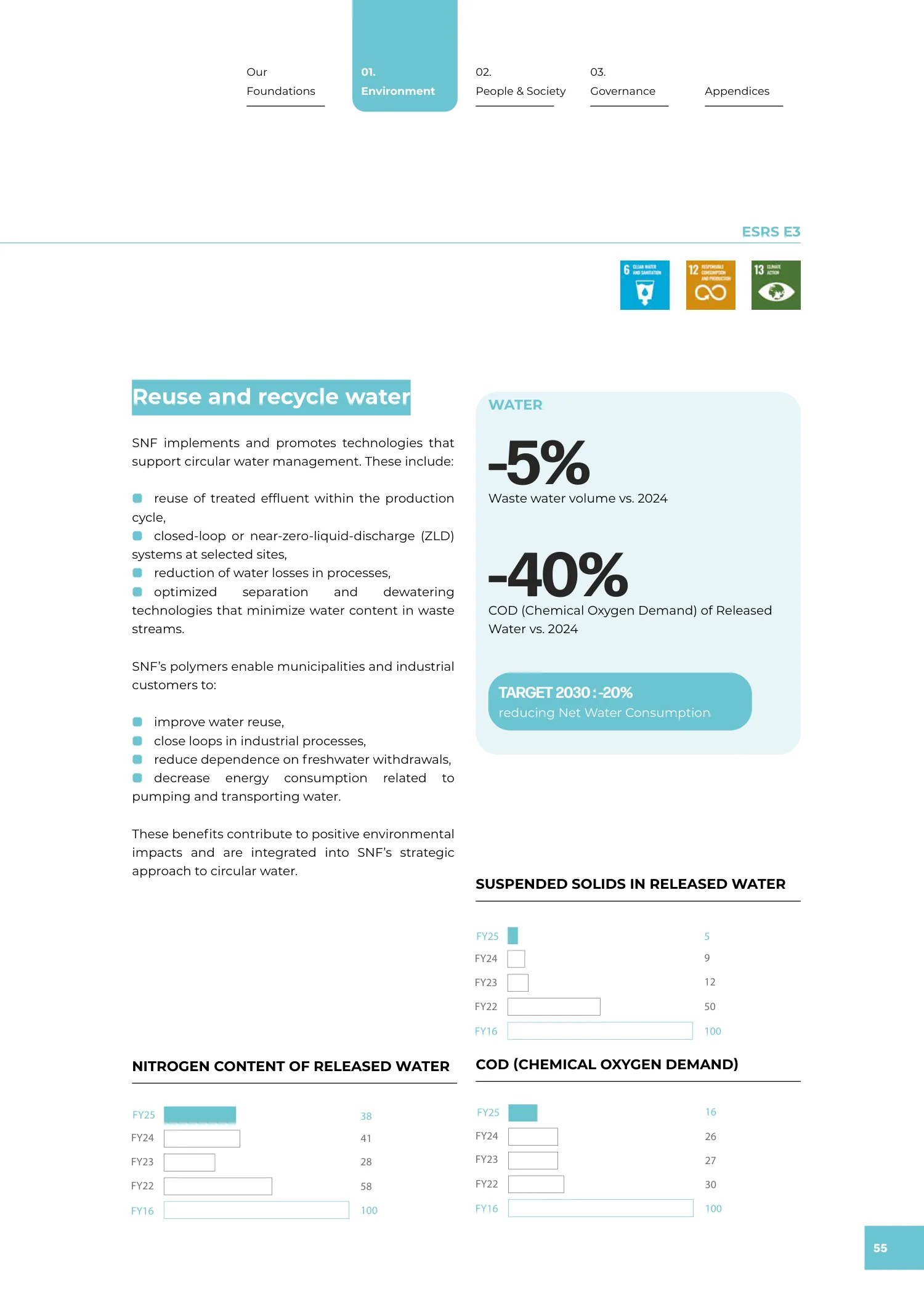
WATER
-5% Waste water volume vs. 2024
-40% COD (Chemical Oxygen Demand) of Released Water vs. 2024
TARGET 2030 : -20% reducing Net Water Consumption
2 pages1.6 Toward Circularity and Resource Efficiency
SNF's circularity approach focuses on efficient raw-material use, waste prevention, recovery, recycling, and lower-impact feedstocks. The Group is also developing bio-based and mass-balance solutions while improving packaging and production efficiency.
Accessible text version of this section
Report page 56
1.6 Toward Circularity
And Resources Efficiency
SNF’s approach to resource use and circularity is rooted in the long-standing optimization of its polymer production processes and in the continuous search for solutions that reduce the environmental footprint of raw materials, intermediates, and final products. Resource efficiency, waste reduction, and the use of more sustainable feedstocks are essential components of SNF’s industrial strategy and reflect the company’s commitment to responsible chemistry.
Waste
SNF manages waste, intending to minimize generation at the source and increase recovery whenever possible. Waste streams vary across the Group’s industrial footprint but typically include packaging, off-spec materials, sludges, and process-derived residues. In all facilities, waste is tracked and handled in accordance with local regulatory requirements and internal environmental-management standards.
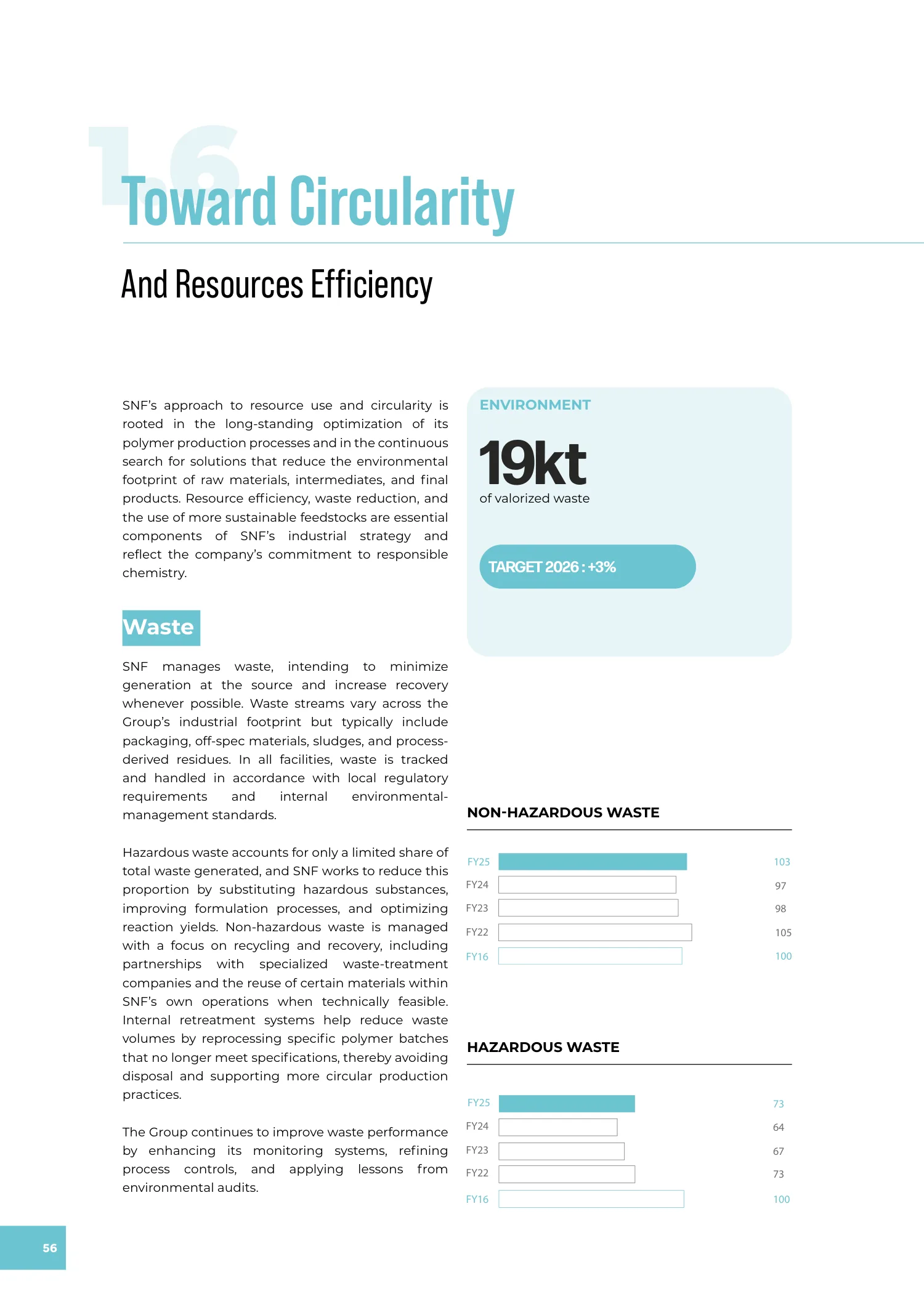
Hazardous waste accounts for only a limited share of total waste generated, and SNF works to reduce this proportion by substituting hazardous substances, improving formulation processes, and optimizing reaction yields. Non-hazardous waste is managed with a focus on recycling and recovery, including partnerships with specialized waste-treatment companies and the reuse of certain materials within SNF’s own operations when technically feasible. Internal retreatment systems help reduce waste volumes by reprocessing specific polymer batches that no longer meet specifications, thereby avoiding disposal and supporting more circular production practices.
The Group continues to improve waste performance by enhancing its monitoring systems, refining process controls, and applying lessons from environmental audits.
ENVIRONMENT
19kt of valorized waste
TARGET 2026 : +3%
Report page 57
Circularity, mass-balance, bio-based share
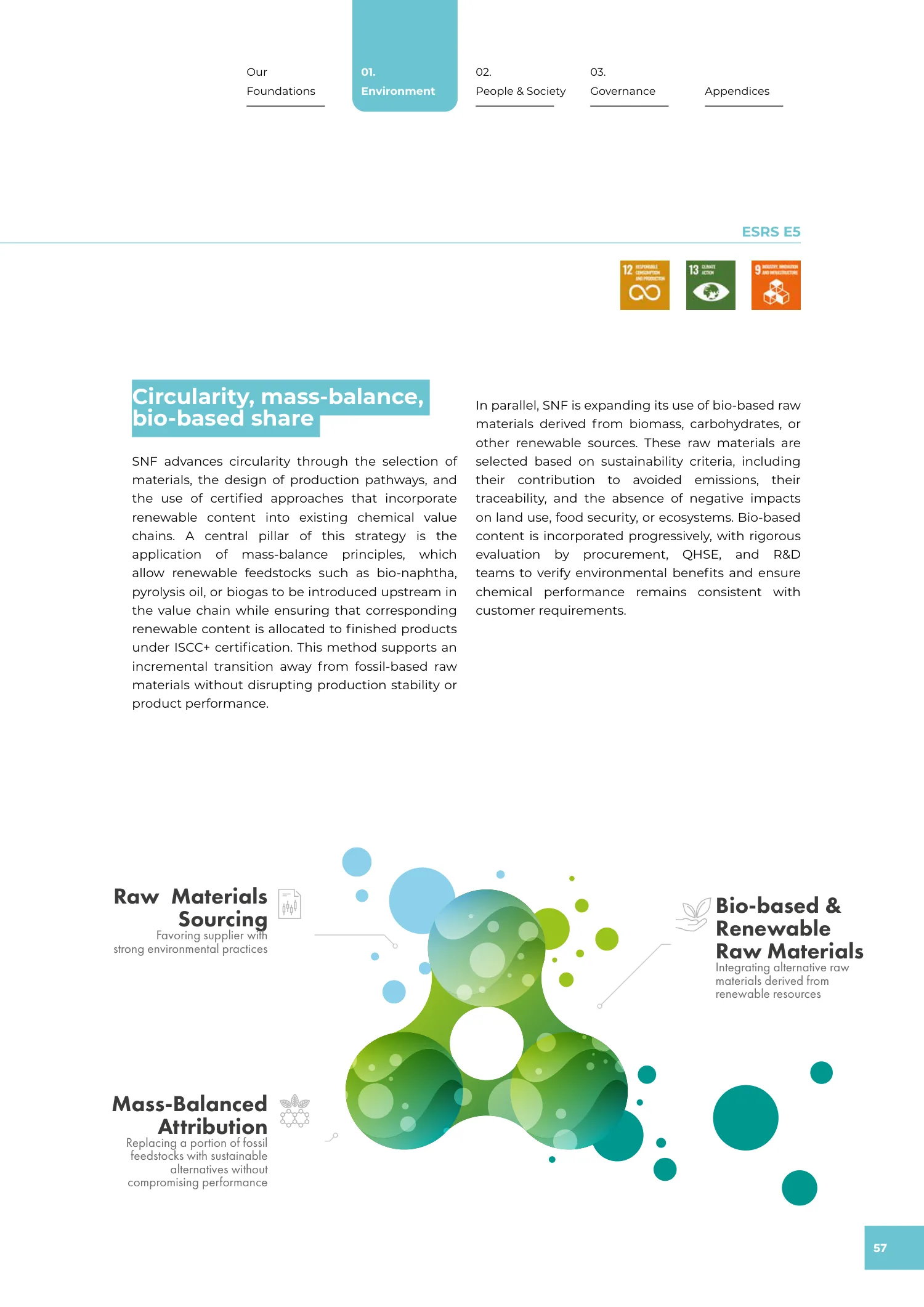
SNF advances circularity through the selection of materials, the design of production pathways, and the use of certified approaches that incorporate renewable content into existing chemical value chains. A central pillar of this strategy is the application of mass-balance principles, which allow renewable feedstocks such as bio-naphtha, pyrolysis oil, or biogas to be introduced upstream in the value chain while ensuring that corresponding renewable content is allocated to finished products under ISCC+ certification. This method supports an incremental transition away from fossil-based raw materials without disrupting production stability or product performance.
Raw Materials Sourcing Favoring supplier with strong environmental practices
Mass-Balanced Attribution Replacing a portion of fossil feedstocks with sustainable alternatives without compromising performance
ESRS E5
In parallel, SNF is expanding its use of bio-based raw materials derived from biomass, carbohydrates, or other renewable sources. These raw materials are selected based on sustainability criteria, including their contribution to avoided emissions, their traceability, and the absence of negative impacts on land use, food security, or ecosystems. Bio-based content is incorporated progressively, with rigorous evaluation by procurement, QHSE, and R&D teams to verify environmental benefits and ensure chemical performance remains consistent with customer requirements.
Bio-based & Renewable Raw Materials Integrating alternative raw materials derived from renewable resources
2 pagesShowcasing Our Actions
Examples from SNF subsidiaries demonstrate practical environmental improvements completed during 2025. Projects include emissions-control upgrades, renewable energy, energy-efficiency measures, waste recovery, water reuse, process optimization, and local environmental partnerships.
Accessible text version of this section
Report page 58
1.1 Showcasing our Actions
Throughout 2025, SNF subsidiaries converted environmental management into a driver of operational excellence. Actions focused on cutting emissions, expanding circular resource flows, reinforcing water stewardship, and improving energy efficiency-fully aligned with the Group’s ambition to decarbonize and operate sustainably.
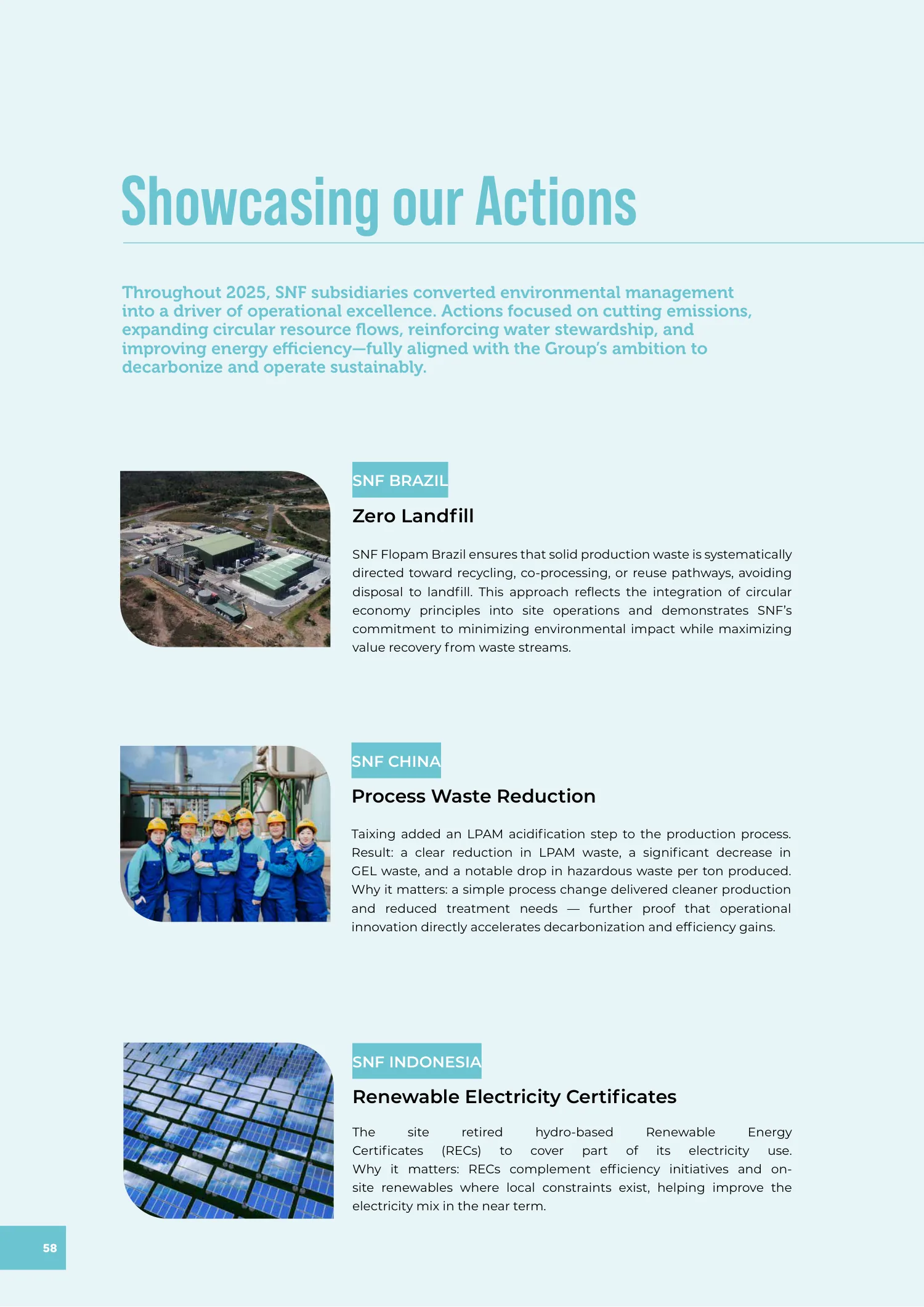
SNF BRAZIL
Zero Landfill
SNF Flopam Brazil ensures that solid production waste is systematically directed toward recycling, co-processing, or reuse pathways, avoiding disposal to landfill. This approach reflects the integration of circular economy principles into site operations and demonstrates SNF’s commitment to minimizing environmental impact while maximizing value recovery from waste streams.
SNF CHINA
Process Waste Reduction
Taixing added an LPAM acidification step to the production process. Result: a clear reduction in LPAM waste, a significant decrease in GEL waste, and a notable drop in hazardous waste per ton produced. Why it matters: a simple process change delivered cleaner production and reduced treatment needs - further proof that operational innovation directly accelerates decarbonization and efficiency gains.
SNF INDONESIA
Renewable Electricity Certificates
The site retired hydro-based Renewable Energy Certificates (RECs) to cover part of its electricity use. Why it matters: RECs complement efficiency initiatives and on-site renewables where local constraints exist, helping improve the electricity mix in the near term.
Report page 59
SNF CHINA
VOC & NOx Reduction
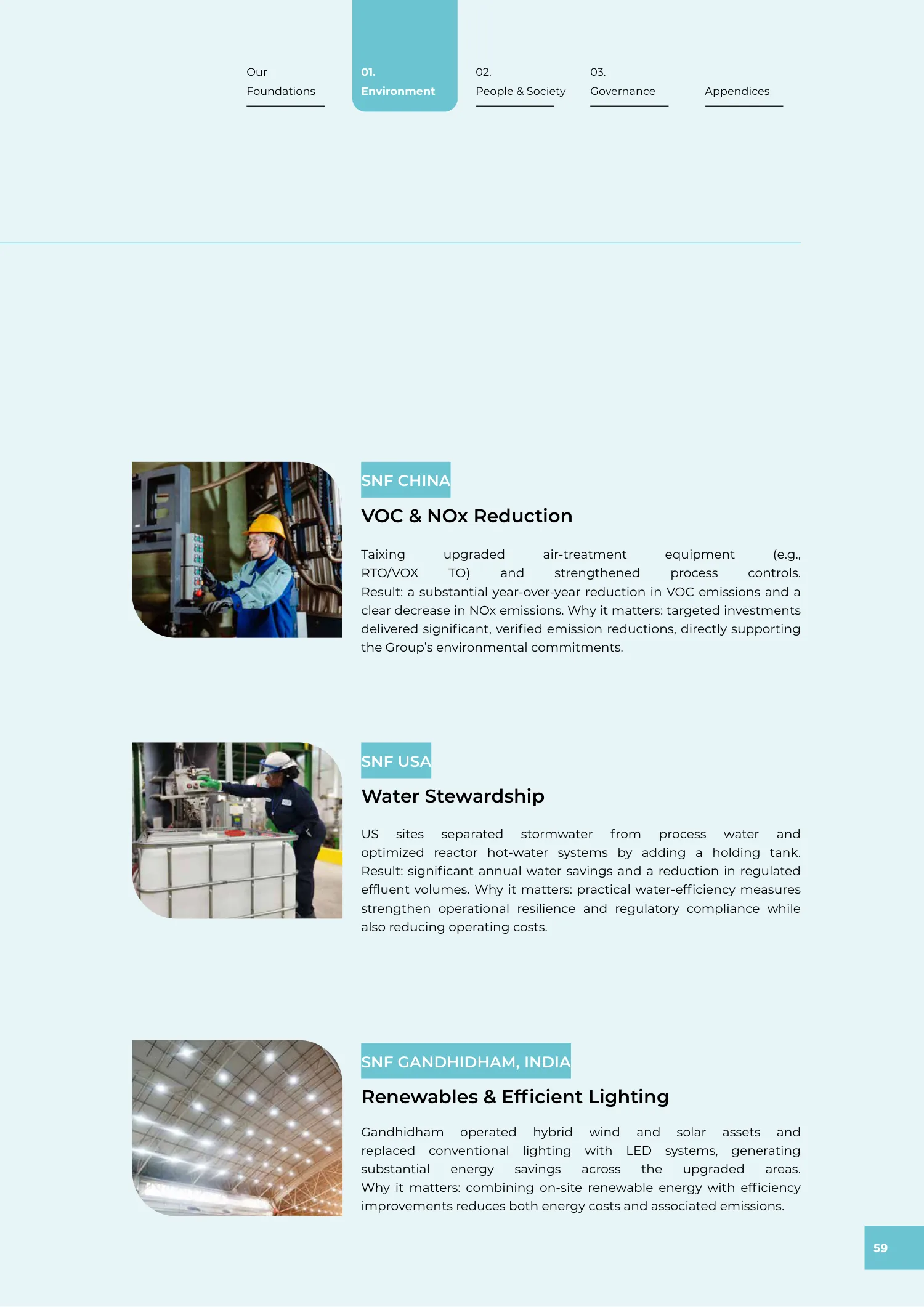
Taixing upgraded air-treatment equipment (e.g., RTO/VOX TO) and strengthened process controls. Result: a substantial year-over-year reduction in VOC emissions and a clear decrease in NOx emissions. Why it matters: targeted investments delivered significant, verified emission reductions, directly supporting the Group’s environmental commitments.
SNF USA
Water Stewardship
US sites separated stormwater from process water and optimized reactor hot-water systems by adding a holding tank. Result: significant annual water savings and a reduction in regulated effluent volumes. Why it matters: practical water-efficiency measures strengthen operational resilience and regulatory compliance while also reducing operating costs.
SNF GANDHIDHAM, INDIA
Renewables & Efficient Lighting
Gandhidham operated hybrid wind and solar assets and replaced conventional lighting with LED systems, generating substantial energy savings across the upgraded areas. Why it matters: combining on-site renewable energy with efficiency improvements reduces both energy costs and associated emissions.